

A Practical Guide to Choosing the Right Cloud ERP Platform
DOWNLOAD THE COMPARISON MATRIX NOWEnterprise Resource Planning (ERP) software sits at the core of how organizations run financially, operationally, and strategically. From managing core financials and supply chains to supporting manufacturing execution, compliance, analytics, and growth, ERP decisions shape not just how work gets done today, but how scalable and resilient a business can be tomorrow.
Choosing the right ERP platform is one of the most consequential technology decisions an organization will make. A strong fit can enable operational clarity, real-time insight, and long-term value. A poor fit, on the other hand, often results in cost overruns, stalled implementations, workarounds, and ultimately re-platforming.
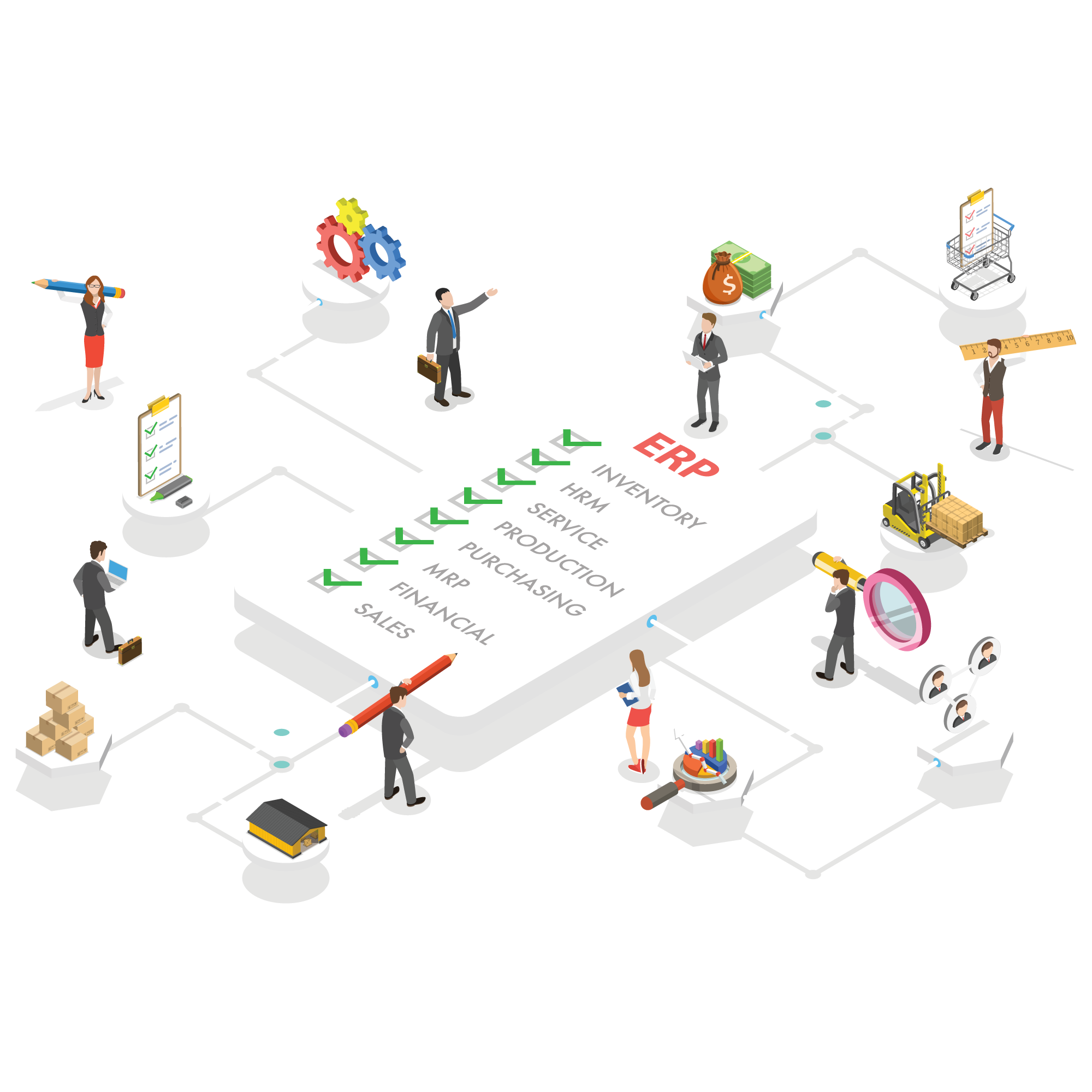
The challenge is that ERP selection rarely comes down to a single feature or vendor ranking. Instead, the right choice depends on a careful balance of:
- Industry-specific functionality
- Manufacturing and distribution requirements
- Technology architecture and integration flexibility
- Ease of implementation and long-term support
- Alignment with how your business actually operates
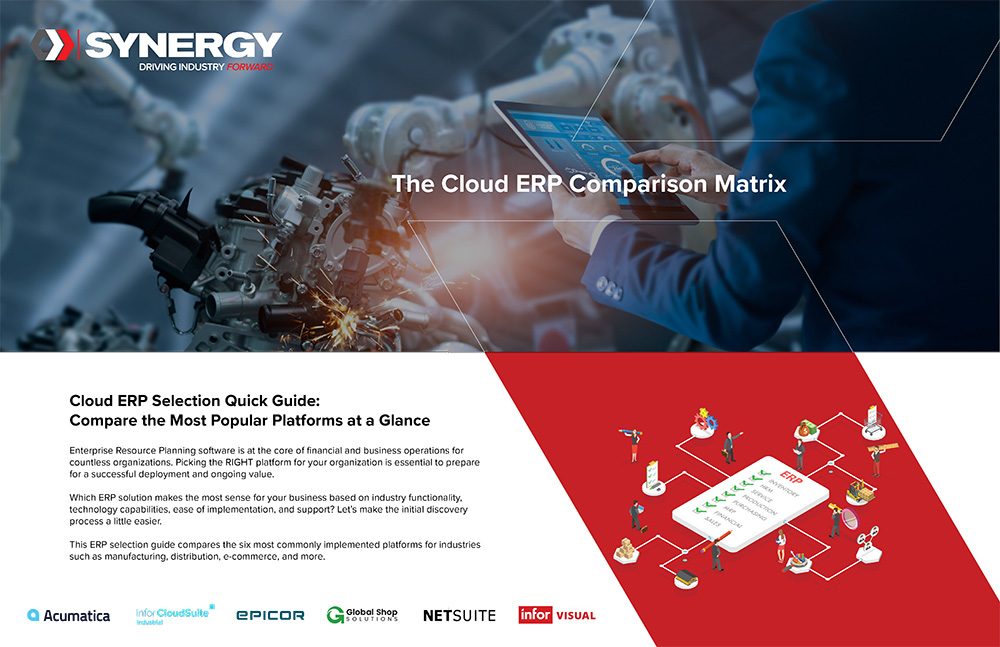
To make the early stages of this process more manageable, WM Synergy developed a Cloud ERP Comparison Matrix that evaluates six of the most commonly implemented ERP platforms across manufacturing, distribution, e-commerce, and related industries.
This guide is designed to serve as a starting point, helping you narrow options, ask better questions, and prepare for deeper discovery.
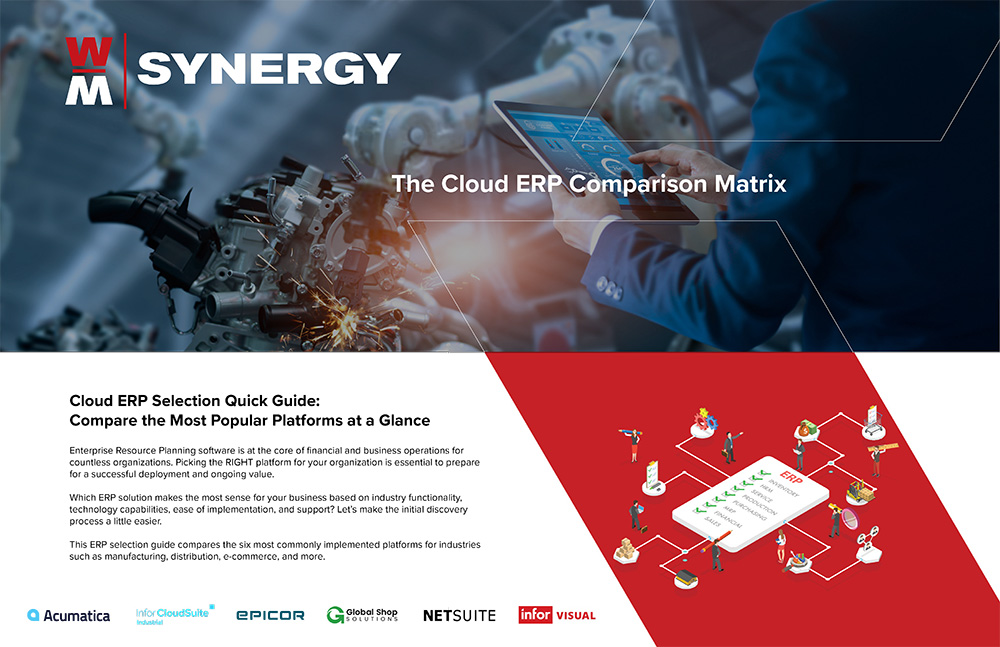
The WM Synergy Cloud ERP Comparison Matrix evaluates the following ERP platforms:
- Acumatica
- Infor VISUAL
- Infor CloudSuite Industrial (CSI)
- Epicor
- Global Shop Solutions
- NetSuite
Each platform is assessed across three major dimensions:
- Functional Fit
- Technology & Architecture
- Implementation, Support, and Business Practices
Rather than declaring a single “best” ERP, the matrix highlights where each solution excels, where it is adequate, and where tradeoffs exist, based on real-world implementation experience and long-term customer outcomes.
Functional Fit: Matching ERP Capabilities to Real Operations
ERP systems are often evaluated through demos that showcase breadth, but long-term success is determined by depth in the areas that matter most to your business.
Core Business Functions
The matrix compares platforms across foundational ERP capabilities such as:
Core financials and multi-entity support
- Distribution and warehouse management
- Discrete and process manufacturing
- Project accounting and field service
- CRM, supplier collaboration, and customer portals
- Product configuration (CPQ) and production scheduling
Some platforms, such as Acumatica, Infor CSI, and Infor VISUAL, demonstrate strong alignment with manufacturing-centric workflows, including true Bills of Manufacture, advanced scheduling, and shop-floor visibility. Others, such as NetSuite, excel in financial consolidation and multi-entity management, with manufacturing functionality often introduced later or via workarounds.
Industry-Specific Strengths Matter
One of the most common causes of ERP dissatisfaction is selecting a platform that is technically capable, but not opinionated enough about your industry.
The matrix evaluates industry readiness across sectors such as:
- Food & Beverage
- Pharmaceutical and Chemical
- Aerospace & Defense
- Automotive
- Medical Devices
- Machinery & Equipment
- Furniture and Distribution
For regulated or engineering-driven industries, platforms like Infor CSI, Acumatica, and Infor VISUAL demonstrate deeper native support for compliance, traceability, and complex manufacturing scenarios. In contrast, some solutions rely more heavily on third-party tools or customization to close industry gaps.
Technology & Architecture: Planning Beyond Go-Live
ERP selection is not just about what a system does today – it’s about how well it can evolve with your business.
Cloud Models and Data Ownership
The matrix highlights important architectural differences, including:
- Multi-tenant vs single-tenant cloud
- Cloud-only vs hybrid or on-premise options
- Database technologies and data accessibility
These distinctions have real implications for scalability, reporting, integration, security, and long-term cost of ownership. For example, some platforms provide strong flexibility and data ownership, while others impose constraints that only surface once reporting, analytics, or contract changes occur.
Integration, Analytics, and AI Readiness
Modern ERP environments rarely exist in isolation. Integration capabilities, API maturity, analytics tooling, and AI readiness increasingly differentiate platforms.
The comparison assesses:
- API and integration frameworks
- Machine and IIoT connectivity
- Native analytics and dashboarding
- Emerging AI and machine learning capabilities
Platforms like Infor CSI stand out for advanced analytics and AI-enabled roadmaps, while others offer more limited or add-on-dependent approaches.
Implementation & Support: Where ERP Success Is Won or Lost
Many ERP challenges don’t originate in software, they emerge during implementation.
Implementation Risk and Change Management
The matrix evaluates factors such as:
- Implementation approach and flexibility
- Likelihood of change orders
- Partner ecosystem depth
- Customer choice in deployment
Some platforms and ecosystems are more prone to costly change orders and phased functionality, especially when manufacturing requirements are underestimated early. Others support more predictable, fixed-fee approaches when implemented with experienced partners.
Long-Term Viability and Support
ERP is a long-term investment. Vendor stability, product direction, consulting communities, and customer access to data all influence the durability of your decision.
The comparison includes perspectives on:
- Vendor scale and product viability
- Strength of consulting ecosystems
- Support models and customer satisfaction
These factors often matter more five years in than they do during selection.
How to Use This Guide and What Comes Next
This ERP comparison matrix is not intended to replace detailed discovery, process mapping, or technical evaluation. Instead, it is designed to:
- Help you eliminate poor-fit platforms early
- Frame better, more informed questions
- Prepare stakeholders for deeper ERP conversations
To support that next layer of decision-making, WM Synergy has developed detailed head-to-head ERP comparison pages that explore real-world tradeoffs between platforms such as Acumatica vs. NetSuite, Infor CSI vs. Epicor, and others.
Each comparison builds on this matrix and dives deeper into:
- Operational fit
- Implementation realities
- Long-term scalability considerations
WM Synergy’s Perspective
At WM Synergy, we work at the intersection of business process, technology, and people. Having supported more than 1,800 ERP implementations, we’ve seen firsthand that ERP success depends less on feature checklists and more on alignment between the platform and how an organization actually operates.
The goal of this guide is not to push a particular solution, but to help leaders make confident, informed ERP decisions that support growth, not just go-live.