

ERP FedRAMP-Authorization Speeds CMMC 2.0 Compliance and Why it Matters to Defense Contractors

A strategic advantage for Defense Contractors in the race for Government Contracts is speed. Speed to respond, speed to produce, speed to deliver, speed to innovate and speed to quality. The US Government expects all these attributes and more from Defense Contractors and the products they produce; including ‘speed to comply’ in protecting CUI data in the cloud.
Proving cyber-security of Controlled Unclassified Information (CUI) that CMMC 2.0 certification requires, is a competitive roadblock for achieving contract award. A proven strategy for ‘speed to comply’, amongst other benefits, is implementing a FedRAMP-authorized (Moderate) Enterprise Resource Planning (ERP) system. Most of the time-consuming work done by the vendor in authorizing their ERP, is reusable for CMMC, virtually guaranteeing compliance, faster.
FedRAMP is focused on the Cloud Services Providers (CSP’s) processes and information, whereas CMMC 2.0 is focused on the Defense Industrial Base (DIB) processes and information. The two are very interrelated.
The FedRAMP authorization process for the ERP Vendor is extensive, involving documentation, independent audits, remediation, and continuous monitoring of 335 control points. Without a FedRAMP-authorized ERP, contractors must shoulder these costs and complexities themselves. It takes on average 12-18 months to achieve CMMC 2.0 compliance. A FedRAMP-authorized ERP cuts months out of this process.
Financial burdens without a FedRAMP-authorized ERP
Full-scope security assessment
· Initial assessment: With a non-FedRAMP ERP, you must pay for a full assessment of all cloud services to ensure they meet the security requirements laid out in NIST SP 800-171, which aligns with CMMC Level 2.
· Third-Party Assessor fees: These assessments must be conducted by Certified Third-Party Assessment Organizations (C3PAOs), who charge fees ranging from tens of thousands to hundreds of thousands for higher CMMC levels.
· Continuous monitoring: After the initial assessment, you must bear the ongoing costs for continuous monitoring, which includes regular vulnerability scans and maintaining system security plans, upgrades and enhancements to the ERP.
· Body of Evidence (BoE) – BoE is the proof of compliance and requires SSPs and CRMs that are the responsibility of the contractor to create and furnish to the CMMC auditor. ERP is complex, as is the burden of validating CUIs.
Documentation and policy development
· Custom documentation: FedRAMP-authorized providers furnish extensive documentation, including BoE, out of the box that you can leverage for your CMMC compliance. Without this, you must develop your own system security plan (SSP), policies, and procedures from scratch.
· Higher consulting costs: Developing this documentation in-house is a labor-intensive process. Many companies hire specialized consultants, which can cost tens of thousands of dollars.
Technology and infrastructure upgrades
· Remediation expenses: A C3PAO assessment on your non-compliant ERP is likely to uncover security gaps. You will have to pay for the resulting remediation work, which can include purchasing new software, hardware, or services.
· Non-compliant software costs: You may discover that a non-FedRAMP-authorized ERP and its related modules or integrations do not meet federal security standards. This could force a costly migration to another system or require extensive retrofitting to achieve compliance.
Staffing and resource strain
· Increased internal effort: Achieving CMMC compliance with a non-FedRAMP-authorized system places a greater burden on internal IT and security teams. They must spend significant time and resources managing the ERP’s security, conducting assessments, and maintaining compliance.
· Expertise shortages: Your internal staff may lack the specific expertise required for complex federal cybersecurity mandates, forcing you to hire costly external consultants to fill knowledge gaps.
Strategic advantages of a FedRAMP-authorized ERP
By leveraging an ERP that already has FedRAMP authorization, contractors can avoid or significantly reduce many of the direct and indirect costs and time associated with CMMC. The ERP provider’s existing security framework and third-party validation simplify the CMMC process and accelerate compliance. This strategy allows contractors to focus their resources on other areas of their compliance framework instead of building security controls for the ERP from the ground up. Speed to implement these controls is greatly improved.
Bottom Line for Tier 2/3 Contractors
· FedRAMP-authorized ERP software (SaaS) = “plug-and-play” compliance. It offloads a massive chunk of the supplier’s CMMC responsibility to the software vendor, who has already undergone independent third-party assessment (C3PAO) and continuous monitoring.
- Less cost
- Faster CMMC compliance
- Reduced risk and implementation times
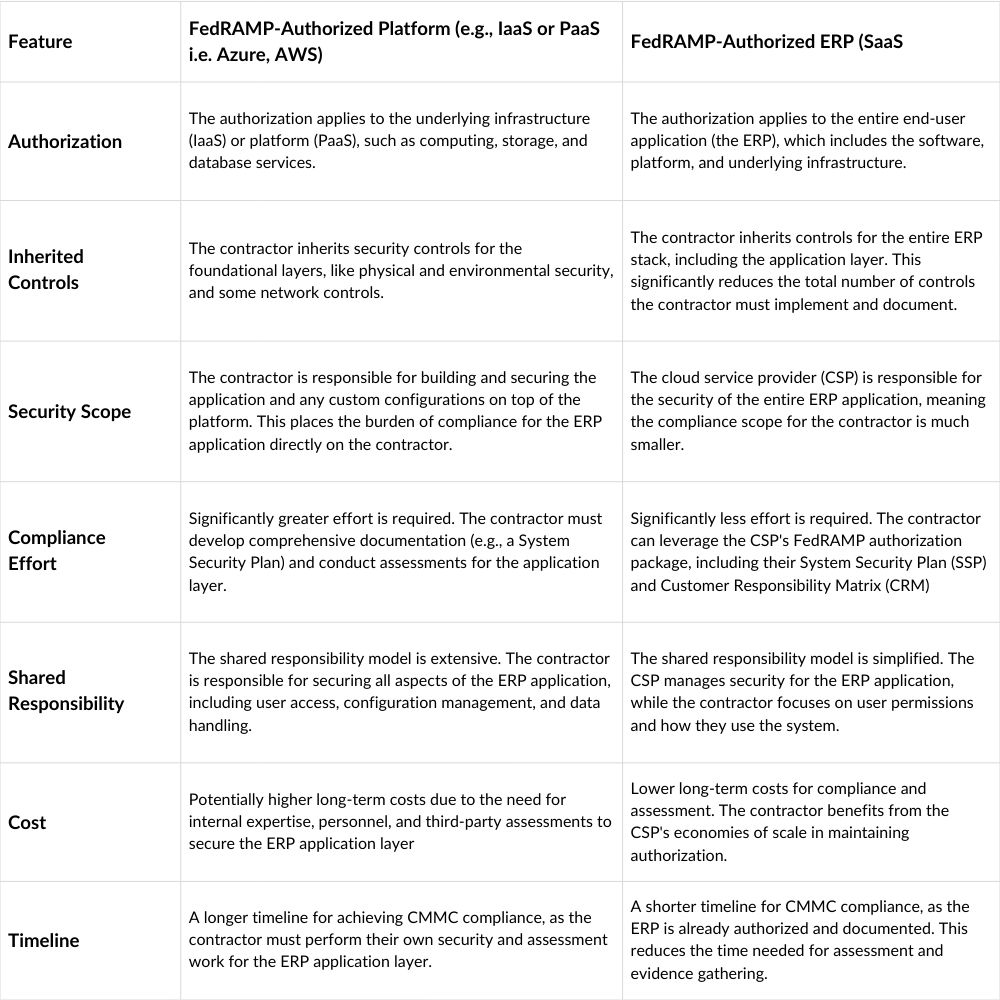
Option 1 – A FedRAMP Authorized Platform & A Non-FedRAMP Authorized ERP
A FedRAMP-authorized platform (e.g. GovCloud, AWS) does not mean the ERP is FedRAMP-authorized. But if the ERP is FedRAMP-authorized, both are authorized. To be clear, an ERP never inherits a platform’s authorization. Vendor’s who claim to be operating in a GovCloud (or, Government Cloud, Azure) environment that is FedRAMP-authorized can be misleading to assume similar authorization (and benefits) of ERP authorization. ERP FedRAMP “Equivalency”, “In-Process”, or “Ready” does not guarantee the controls (and benefits) of authorization. A contractor using a fully authorized ERP benefits from maximum security inheritance, whereas using a FedRAMP-authorized platform and a non-FedRAMP-authorized ERP, still requires the contractor to build and secure the ERP application layer themselves.
Comparison Overview
Option 2 – On-Premise ERP vs. FedRAMP-authorized ERP & CMMC 2.0 compliance
On-premises ERPs require the organization to build and maintain every security control. Using a FedRAMP-authorized ERP allows for “inheritance” of many pre-validated security controls. This shift from an ownership to a shared responsibility model significantly alters the cost structure.
Cost Structural Differences
The financial impact shifts from capital expenditure (CapEx) for physical security and hardware to operational expenditure (OpEx) for specialized cloud licensing.
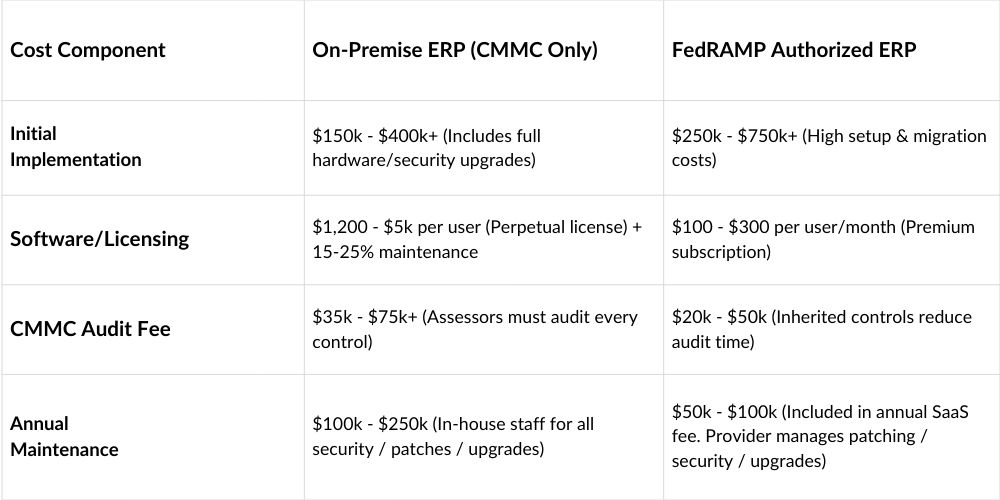
· Audit Scope Reduction: FedRAMP-authorized systems come with a pre-validated security package. This can reduce your CMMC audit scope for the ERP portion by 65% or more, as many NIST 800-171 controls are already met by the cloud provider.
· Physical Infrastructure Savings: On-premise requires CapEx for secure server rooms and specialized physical access controls. A FedRAMP ERP offloads these costs to the provider.
· Licensing Premium: “Government-grade” or FedRAMP-authorized versions of software (e.g., GCC Moderate for Infor) typically cost significantly more than standard commercial versions, often by 30-50% or more.
Side-by-Side Cost Comparison (Estimated)
Key Cost Advantages of FedRAMP ERPs
· Faster Certification: Achieving CMMC Level 2 typically takes 12–18 months. Using a FedRAMP-authorized ERP can accelerate this by several months because you avoid building the baseline for your core data environment.
· Lower Compliance Labor: On-premise systems require continuous manual monitoring and patching by internal IT staff. FedRAMP ERPs automate much of this, reducing annual personnel costs by roughly 30%.
· Predictable Reporting: Because the ERP provider must maintain their own FedRAMP status, they provide the standardized evidence needed for your annual CMMC affirmations, reducing consultant fees for documentation.
· Automated Upgrades & Enhancements: A multi-tenant, FedRAMP ERP provides automatic upgrades and enhancements, eliminating the cost associated with ongoing maintenance and compliance.
The “right” choice depends on your needs
For Defense Industrial Base (DIB) contractors handling Controlled Unclassified Information (CUI), a fully FedRAMP-authorized ERP (Software-as-a-Service, or SaaS) is the most efficient and least risky path to CMMC 2.0 compliance. It provides the highest level of security inheritance and reduces the contractor’s compliance burden.
A FedRAMP-authorized platform ONLY (Platform-as-a-Service or PaaS) may be appropriate for contractors with unique, highly customized ERP requirements. This approach allows for greater flexibility but requires a substantial investment in internal
security and compliance resources to secure the application layer. Ultimately, the cost and effort of achieving CMMC compliance will be significantly higher without a fully authorized cloud ERP.
On-Premises, or Hybrid options that keep CUI “inside the four walls” is also an option that can be attractive due to lower licensing cost and customizations flexibility, but, typically highly discouraged due to high hardware and internal infrastructure costs, internal IT resource requirements, and obsolescence risks of on-premises versions of ERP. Microsoft, Epicor, SAP, Oracle and many more ERP vendors have publicly announced a ‘cloud first’ strategy of product development, which limits future enhancements, has higher upgrade costs, and is becoming more limited to find outside expertise and support.
Bottom Line for Tier 2/3 Contractors
· FedRAMP-authorized platform (IAAS or PAAS) = Infrastructure is secure, but the application layer remains a compliance gap. Contractors end up owning the risk and effort, which is:
- Expensive
- Slow
- Increasingly unacceptable to primes and DoD assessors
- Single Tenant, platform-authorized only deployment is similar to On-Premise deployment in cost structure, with the exception of physical infrastructure transitioning to PaaS and IaaS fees. Upgrades and Enhancements are manual.
Advice for Evaluators
Many A&D contractors now include, “FedRAMP Moderate Authorized” on their RFP’s for new ERP as a hard requirement in vendor evaluations — because failing CMMC can mean losing existing contracts or being excluded from future bids. Investing in FedRAMP-authorized tools is seen as a strategic enabler for staying competitive in the DoD supply chain.
On-Premise or Hybrid deployments that keep CUI “in-house” are less costly up-front but are higher in ongoing costs and present significant risk of de-support or sunsetting by the vendor. Enhancements of newer technology, such as AI, RPA, IoT and Industry 4.0 may not become available for on-premises versions of the ERP.
Further, a Multi-Tenant ERP that satisfies the functional requirements of the contractor provides additional cost savings with free upgrades and enhancements to evolving technology. Single-Tenant and On-Prem remain optional and manual for upgrades and enhancements.
An ERP FedRAMP authorization search is publicly available and can be found here – www.marketplace.fedramp.gov